
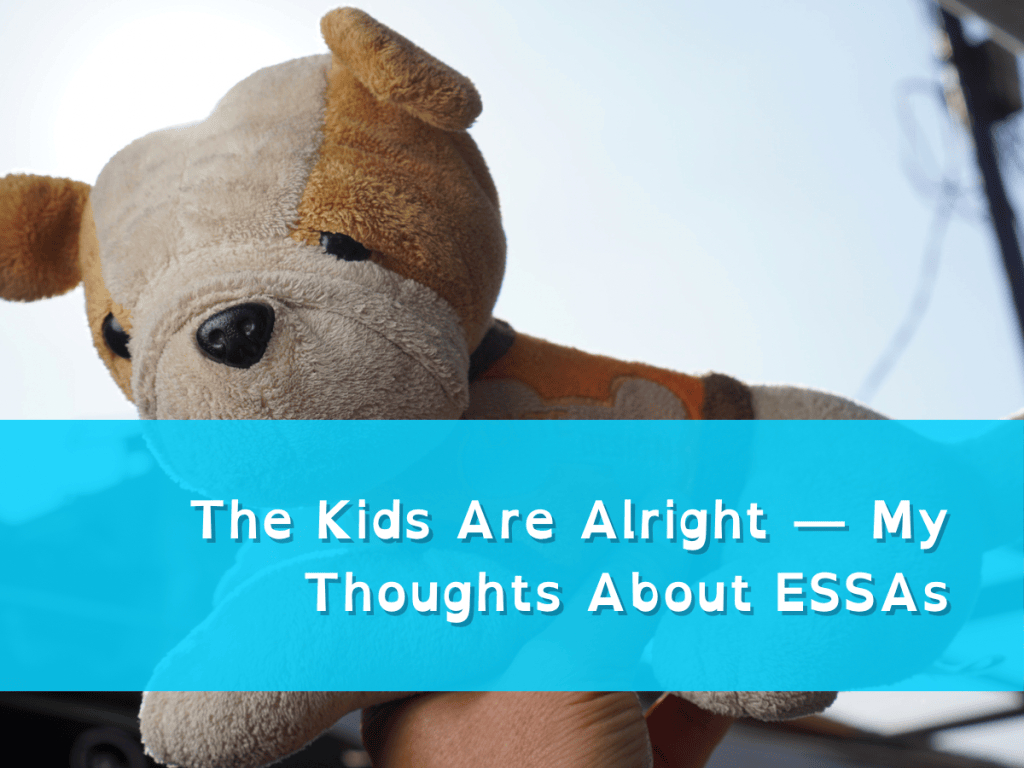
You may have seen videos on TikTok of kids training their plush toys, or perhaps you’ve even seen a teenager in the wild at your local big-box hardware store walking a stuffed animal on a leash and practicing tricks like, “heel,” and, “center.” What some view as immature, silly, or weird, I view in a completely different light.
In fact, it takes a great deal of confidence to go out into public places and to school with a plush toy by your side. People, and especially kids, have a tendency to be incredibly cruel about things they don’t understand or that go against the grain of what society considers, “normal.” The sting of being bullied at the young age of seven for bringing my beloved stuffed Elmo to a sleepover still sits with me in my thirties. So what these teens are doing is quite courageous— I commend them for pushing past the stigma and doing what feels right for them and works to stabilize their mental health.
Personally speaking, I was far too nervous to bring my first service dog, Tz, to high school with me. He was extremely well trained, he was ridiculously friendly, my pediatrician urged me to get and use a service dog for years, and it would have been extremely beneficial for my health to have him accompany me. But I couldn’t bring myself to do it. I was too afraid of being bullied and othered for needing a dog with me at school. Again, kids can be mean. The confidence building I’ve seen with these kids that have an ESSA is just one of the many benefits that an ESSA can provide. There’s tangible value in that which simply cannot be ignored.
What the heck is an Emotional Support Stuffed Animal (ESSA), anyways?
An ESSA is a stuffed animal/plush toy that provides therapeutic benefits through their presence, and people often form an emotional bond with them. They’re very similar to a living emotional support animal, sans the requirements to feed, potty, and exercise them. A living ESA typically requires the owner to have a disabling mental health condition, while there are no requirements for an ESSA. An ESSA can be any type of stuffed animal, but I’ve noticed that people tend to lean towards dogs of various breeds, and many choose breeds they wish they could have or might get in the future as a living dog, such as Labrador Retrievers, Golden Retrievers, Border Collies, and Huskies. People often dress their ESSAs up in collars, bandanas, harnesses, and even custom gear, much like one would do with a living dog.
You may be wondering: why might someone choose an ESSA over a living animal?
Perhaps the child’s parent(s)/guardian(s) won’t allow them to have a living animal for various reasons. Maybe their schedule is too hectic or their disability creates a barrier in being able to care for a living animal. It’s also possible that they’re simply not ready for a living animal yet, so an ESSA allows them the opportunity to prepare for what it will look and feel like to have a living animal, and the time commitment involved through role-play.
ESSAs can also be a fantastic way to prepare for a living service dog. I’ve seen several videos in which teenagers are practicing real-life skills and tricks with their stuffie companions that my own real service dogs have to perform on a daily basis. Frankly, many of these kids would make excellent puppeteers with the way they’re able to maneuver inanimate animals in such lifelike ways, and I’m all for building and maintaining good dexterity and hand-eye coordination. The fact that they’re practicing obedience commands and tricks with stuffed animals genuinely gives me hope that a bigger part of the next generation of dog owners will have well-trained living dogs if they end up getting one later on.
Other benefits of ESSAs might include: emotional regulation and/or grounding support via petting, depression and anxiety relief through knowing they have a little stuffed buddy to get them through something difficult, lowering stress through self-soothing, creating healthy routines by giving the person “tasks” to do through role-play (ex: getting up in the morning to take care of their ESSA, eating their own food while they “feed” their ESSA, drinking water when they want to offer some to their stuffie, etc.), learning hygiene skills through washing/“grooming,” their stuffed companion, and more.
These kids aren’t, “weird,” and there’s nothing “wrong” with them— quite the opposite, in fact.
Stuffed animals are known as transitional objects in psychology, and have very real, well-studied, proven psychological benefits for both children and adults. Fostering imaginative play by way of ESSA in a child’s teenage years is a great way to build and expand creative thinking, independence, emotional regulation, and social development skills that they will need as they transition into adulthood. Many esteemed colleges have implemented the use of plush toys and stuffed animals in group settings to alleviate stress and promote easier conversation between students. Stuffed animals are often used in senior living homes and as a part of dementia patients’ care plans with great success as well. People of all ages seem to benefit from plushies. Using a stuffed animal to cope with life’s stresses is quite normal, and often encouraged by mental health professionals.
The only time and reasons I personally would have concerns about a child using an ESSA is the same time and reasons I would have concerns about children who use a living ESA or Service Dog: if the child cannot function without their ESSA, ESA, or SD, or, the child is becoming withdrawn and exhibiting antisocial behavior, then you may need to seek out the advice of a mental health professional for safer, more effective coping strategies and skills. Service dogs and living ESAs alike need down-time, can get sick or injured, and children have to learn to manage their disability/disabilities without them at times. Similarly, a stuffed animal might get badly soiled, lost/misplaced, or not be allowed into certain venues. If the child cannot cope without their support animal or SD for some periods of time, then a mental health professional needs to step in to assist. Same concerns, regardless of the tool being used to mitigate their disability/disabilities or mental health struggles* (*which may or may not be disabling, but still needs to be treated with importance).
People with ESSAs aren’t hurting anyone. Some of these kids may have a mental illness, but their mental illness doesn’t stem from bringing a stuffed animal with them to school or out in public. And even if they don’t have a mental illness, life and school can be incredibly stressful— so it’s important to take care of their psychological health. If an ESSA helps them, that’s great! A stuffed animal is far more convenient and cost effective than utilizing a living Emotional Support Animal or Service Dog, and they can be wonderful practice for the real thing someday.
The kids are alright. Let them be, and mind your business as a bystander. If you have respectful questions to ask in good faith, then I’m sure they’d be happy to tell you more about their plushie friend. And if they aren’t, you need to be okay with that and move along. The world would be a better place if we can all have an open mind about how people safely cope with life’s stressors and mental health struggles. This falls squarely into that category, and I implore anyone reading to consider the many positive aspects of an ESSA before invalidating their usefulness.
Studies:
https://icjs.us/the-positives-of-plushies-stuffed-animals-have-benefits-for-children-and-adults/
https://pmc.ncbi.nlm.nih.gov/articles/PMC5333530/
https://digitalcommons.lindenwood.edu/cgi/viewcontent.cgi?article=1004&context=src_2025


Leave a Reply