

July 1st marks the start of Disability Pride Month! ♿️
This month’s celebration originates from the historic passing of the Americans with Disabilities Act (ADA) on July 26th, 1990. Although Disability Pride Month has been recognized and celebrated for 35 years, it still isn’t federally recognized; on-par with the systemic ableism and disability erasure that we are still fighting to this day. New York was the first state to officially observe Disability Pride Month in 2015, but several cities across America have long celebrated with parades & marches, and the number of participating cities continues to grow.
Disability Pride can be described as honoring each person’s unique experience with disability, celebrating how disability shapes our identities, and promoting complete inclusivity. Disability Pride is interconnected with the larger movement for disability justice.

There are two versions of the Disability Pride Flag, both designed by disabled writer, Ann Magill. The first was created in 2019, and the newest was unveiled in October 2021. All six “standard flag colors” were used to represent the pan-national nature of the Disability Community; spanning borders between states and nations. A black field/background symbolizes mourning and rage for victims of ableist violence and abuse.
The White Stripe: Invisible and Undiagnosed Disabilities
The Red Stripe: Physical Disabilities
The Gold Stripe: Neurodivergence
The Blue Stripe: Psychiatric Disabilities
The Green Stripe: Sensory Disabilities
The zigzagging lines represented how disabled people are forced to maneuver the barriers we face. Unfortunately, when the flag was viewed on mobile devices, it unintentionally created a flicker/strobe effect, posing danger for people that have visually triggered disabilities, such as seizures and migraines.
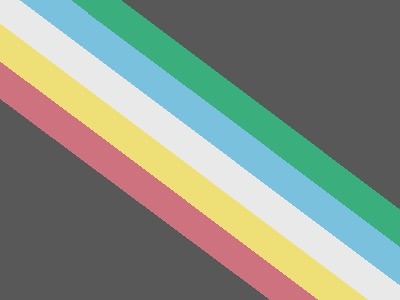
Of the new stripes, Ann states, “The diagonal bands now represent “cutting across” the walls and barriers that separate the disabled from normate society, also light and creativity cutting through the darkness.”
Since the Disability Community is incredibly diverse, Disability Pride Month can provoke various thoughts and feelings within the Community– each disabled experience is unique, but we all share the common denominator of experiencing marginalization and discrimination. This is why we advocate for intersectional approaches to meeting the needs of disabled people, which are often intertwined with: race, age, gender, sexuality, socioeconomics, religion, etc.
While the “Pride” part of this month may be confusing to some (as it follows Pride Month for the 2SLGBTQIA+ community), it follows the same mission of celebrating and reclaiming visibility within our society. Other direct correlations between #PrideMonth and #DisabilityPrideMonth are that the two Communities have survived under comparable systems of oppression, and several advocates for these communities identify as both queer and disabled. Icons like Marsha P. Johnson, Barbara Jordan, and Bobbie Lea Bennett have been pioneers in the fight for 2SLGBTQIA+ and disability rights, as their identities included both groups in addition to other intersections.
This year, those reclamation efforts feel more important than ever. In May, new rules were introduced by the Department of Energy. Docket (DOE-HQ-2025-0015) Rescinding New Construction Requirements Related to Nondiscrimination in Federally Assisted Programs or Activities, and Docket (DOE-HQ-2025-0024) Rescinding Regulations Related to Nondiscrimination in Federally Assisted Programs or Activities (General Provisions) both target existing laws that protect disabled people, and civil rights at large. The comment period has ended, so now we anxiously wait for the outcome. If significant adverse comments were received, they could potentially withdraw the rules or issue new ones.
Further, there’s been a great deal of uncertainty surrounding threats of devastating cuts to Medicaid and Medicare, as well as SNAP. Patients across the country are concerned they will have to ration treatments or go without. Parents are worried about the future of their disabled children’s independence. Chronically ill folx who receive at-home assistance could lose access to that care, which can negatively impact outcomes. Inevitably, many patients will lose access to care altogether if the U.S. Senate passes the “Big Beautiful Bill”. Losing access to food on top of this would have catastrophic consequences.
Edit 07/01/25 10:25 A.M. MDT — This morning, the Senate narrowly passed President Trump’s “Big Beautiful Bill” in a final vote of 51-50. Senator Lisa Murkowski (R-AK) cast a ‘yea’ vote after hours of deliberations overnight secured provisions to the bill that she believes to be “perks” for her home state of Alaska. Vice President JD Vance cast the tiebreaker vote to push the bill forward to the Republican controlled House of Representatives.
In a time where our very existence as disabled people is still deemed “radical,” sharing our stories, struggles, and joy has become a matter of life or death. Throughout history, our Community has accomplished incredible feats by working together. We can further strengthen our Community by leaning on one another, dismantling internalized ableism, recognizing intersectionality, and challenging disability hierarchy. It is estimated that 1 in 4 Americans have a disability, and that is not an insignificant number. Celebrating Disability Pride Month is an act of resistance, rebellion, and peaceful protest. Together, we can make a strong stand against fascism.
By sharing our stories, attending parades/marches, advocating for others, pushing for policy changes, and demanding accountability for systemic ableism, we move towards a more inclusive, accessible, and equitable world.
How are you celebrating Disability Pride this month?
 A Link to the Spoons
Leave a comment